

For decades, mainframes have been at the core of mission critical systems across industries such as banking, insurance, and telecommunications. They are reliable, secure, and capable of processing large volumes of transactions with remarkable consistency. However, as organizations accelerate their digital transformation journeys, a growing tension emerges between the stability of these legacy systems and the agility required by modern data-driven architectures.
This tension is not only technical, but also operational and financial. Mainframes are typically associated with high infrastructure costs, often measured in MIPs (Million Instructions Per Second), where scaling usage directly impacts expenditure. At the same time, accessing data in a flexible and timely way can be complex, limiting the ability to build real time use cases, advanced analytics, or AI driven solutions.
The challenge of integrating legacy systems into modern data architectures
One of the main challenges organizations faces is not the existence of mainframes themselves, but the difficulty of integrating them with modern architecture. Data is often tightly coupled to operational systems, making it harder to expose, process and distribute in a way that supports real time decision making.
At the same time, increasing demand for data driven use cases places additional pressure on these systems. Frequent queries, complex data extraction processes, and growing integration needs can impact performance and increase operational costs. This creates a paradox where the system that holds the most valuable data becomes a bottleneck for innovation.
In practice, organizations typically encounter challenges such as:
- High infrastructure costs driven by MIPs consumption;
- Limited ability to expose data in near real time for downstream systems;
- Strong dependency on legacy systems for operational and analytical workloads;
- Increasing complexity when integrating with cloud native and event driven architectures;
- Performance impact caused by frequent data access from multiple consumers.
These challenges highlight the need for an architectural shift, not necessarily by replacing the mainframe, but by redefining its role within the broader data ecosystem.
From operational dependency to data enablement
Mainframe offload introduces a more balanced architecture, where core systems continue to process transactions while data is replicated into a modern layer. This is often achieved through an Operational Data Layer (ODL), designed to integrate multiple data sources and make them available in near-real time.
By acting as an intermediary between legacy systems and modern applications, this layer allows data to be consumed simultaneously by multiple applications without directly impacting the mainframe. Instead of querying the mainframe for every request, applications rely on a replicated and optimized data store, improving performance, and reducing load on the core system.
In practice, this typically involves using CDC mechanisms to capture changes from the mainframe, reconstruct the data in an operational database, and expose it through APIs for flexible access.
This architectural pattern becomes particularly valuable in scenarios where real-time data availability directly impacts business outcomes. For example, in financial services, enabling near real time access to transaction data allows customers to receive immediate updates on account activity, detect anomalies faster, and trigger alerts based on usage patterns.
In retail environments, offloading transactional data can support use cases such as stock updates across stores or real time monitoring of customer activity, improving operational responsiveness, and customer experience.
As organizations evolve, this initial setup can be extended with more advanced capabilities, particularly through the introduction of streaming architectures.
The role of streaming and event driven architectures
A key enabler of mainframe offload is the adoption of event driven architectures. Instead of relying on batch processes or direct system queries, data is continuously distributed through events, allowing downstream systems to react in near real time.
This architectural shift brings several advantages that go beyond performance improvements. It enables a more decoupled ecosystem, where systems are less dependent on each other, and where failures in one component are less likely to propagate across the entire platform. It also creates opportunities to standardize data models and ensure that information is consistently structured before reaching consumption layers.
In practice, this approach has already proven its value in high volume, event driven environments. For instance, streaming platforms can support the distribution of transactional data across multiple systems, enabling use cases such as real time fraud detection, personalized customer notifications, or operational monitoring dashboards.
Benefits: enabling scalability, efficiency and new data capabilities
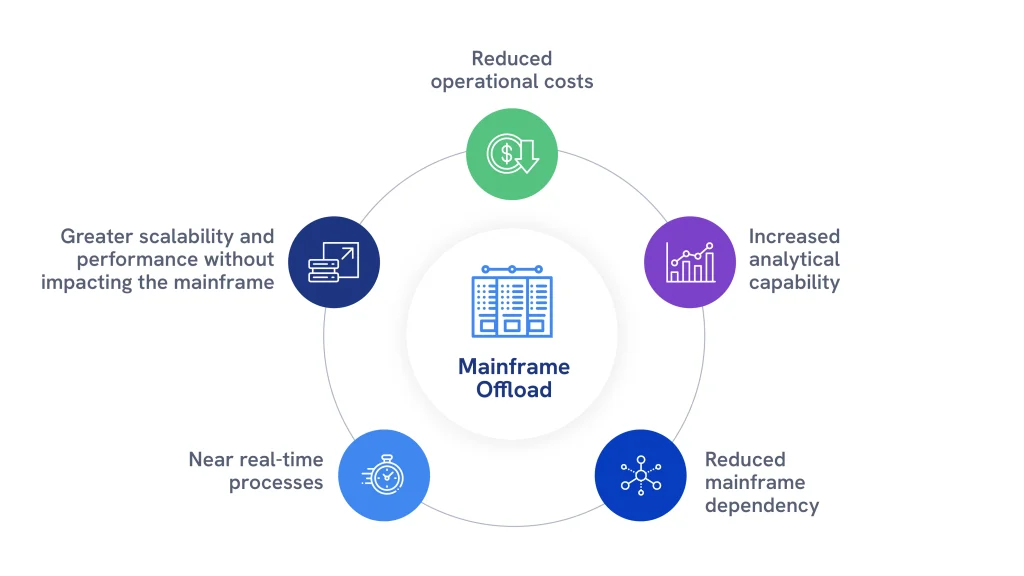
The impact of a well-established mainframe offload strategy extends beyond cost reduction. While lowering MIPs consumption is often a primary driver, the real value lies in enabling new capabilities that were previously constrained by legacy architectures.
By making data more accessible and decoupling it from operational systems, organizations can accelerate the development of real time use cases, improve analytical capabilities, and support more advanced applications such as machine learning and AI.
At Xpand IT, this journey typically starts with understanding the current state of the mainframe ecosystem, including transaction flows, cost drivers, and existing integration mechanisms. From there, we help organizations define an offload strategy that balances technical feasibility with business impact, identifying which data should be replicated, how it should be exposed, and which architectural patterns best support future use cases.
Conclusion: A gradual transformation, not a replacement
Mainframe offload should be seen as a gradual transformation. The goal is not to eliminate legacy systems, but to reposition them within a modern data architecture where they continue to serve their purpose without limiting innovation.
Organizations that adopt this approach are able to strike a balance between stability and agility, preserving the robustness of their core systems while enabling new layers of flexibility, scalability, and data driven innovation.