
In a previous article, I explored how mainframe offload can help organizations unlock data from legacy systems and reduce the operational burden of core infrastructure. By replicating data into modern platforms through CDC (Change Data Capture) mechanisms, organizations gain flexibility, lower infrastructure costs and the ability to expose information that was previously trapped inside tightly coupled systems.
But extracting data is only half the journey. The question that follows – and the one that ultimately determines the business value of the entire effort – is: what happens to that data once it has been freed?
The real transformation begins when data stops being moved periodically and becomes something that flows continuously, reaching the right systems and the right people when is relevant. This is where event-driven architecture becomes the natural next step in the mainframe offload journey.
The limits of thinking in batches
For decades, the dominant approach to data processing has been batch oriented. Data is extracted from operational systems at scheduled intervals, processed and loaded into analytical or reporting layers. This model served organizations well when data volumes were manageable and real-time responsiveness was not a competitive differentiator.
The challenge is that most business processes are not batch-oriented by nature. A customer making a payment does not wait for a nightly job to confirm whether the transaction was approved. A fraud attempt does not schedule itself for off-peak hours. A stock outage across a retail network does not pause until the morning report is generated.
In practice, organizations relying on batch architecture often encounter constraints such as:
- Delayed detection of anomalies and operational issues, increasing their business impact;
- Customer-facing processes that lack the responsiveness expected in digital experiences;
- Analytical and reporting layers that reflect the state of the business hours ago, not now;
- Operational teams working from dashboards that are always catching up, never leading;
- Integration complexity that grows as more systems need access to the same data at different intervals.
These constraints do not stem from a lack of data. They stem from an architecture that treats data as something to be moved periodically rather than something that flows continuously.
A different way of thinking about data movement
Event-driven architectures are built on a fundamentally different premise. Instead of moving data in bulk at scheduled intervals, they treat every change in state as an event, something that happened, that other systems can observe and react to immediately.
A useful way to think about this is the difference between receiving a printed newspaper and having a live news feed. Both deliver information, but only one delivers it at the right moment, when it is relevant. Event-driven architectures apply the same logic to business data: rather than waiting for the next scheduled extraction, systems are notified the moment something meaningful occurs.
This model has an important implication for organizations that have already invested in mainframe offload. The data replicated through CDC – transaction records, account updates, operational events – becomes far more valuable when it is distributed in real time rather than made available in a static store. The offload layer provides the foundation; the streaming layer is what activates it.
Where real-time data creates tangible business value
The value of event-driven architectures becomes most visible when examined through the lens of specific business outcomes.
In financial services, the ability to process transaction events in near real time enables a range of capabilities that are simply not possible in a batch world. Customers can receive immediate notifications after each card transaction, with contextual information that improves their sense of control and security.
Fraud detection models can evaluate patterns as they emerge rather than after the fact, dramatically reducing the window of exposure. Personalized alerts based on spending thresholds or usage patterns can be triggered at the moment they become relevant, rather than the following morning.
In retail, streaming architectures support use cases such as real-time inventory visibility across store networks, enabling more accurate data availability for customers, and faster operational responses to stock variances. Monitoring customer activity across digital and physical channels becomes possible without introducing additional load on core operational systems.
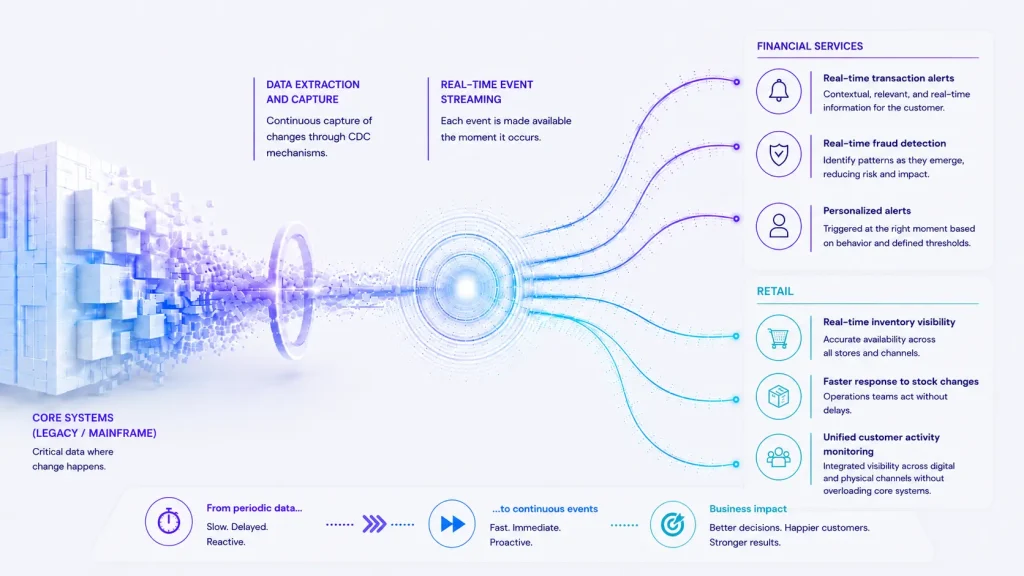
What these examples share is a common pattern: the closer the organization can get to acting on data at the moment it is generated, the greater the business impact.
Turning the streaming architecture into a scalable capability
One of the practical challenges in adopting event-driven architectures is the engineering effort required to build and maintain them consistently. Each new streaming use case carries the risk of becoming a bespoke implementation.
A more sustainable approach involves building a reusable layer that standardizes how streaming use cases are defined, deployed and operated. Rather than rebuilding the same processing logic for each new requirement, teams work with a shared set of components that handle the common patterns – data ingestion, transformation, enrichment, routing to multiple destinations – while remaining flexible enough to accommodate different levels of complexity.
The business implication of this approach is significant. When the foundational work is done once and applied repeatedly, the time to market for new use cases drops substantially.
At Xpand IT, this is how we approach streaming at scale: starting from a solid architectural foundation built on top of the offload layer and then accelerating the delivery of use cases on top of it. The goal is not just to make one use case work well in real time, but to make real-time a capability that the organization can apply broadly.
Conclusion: completing the journey from offload to impact
Mainframe offload creates conditions for transformation, but event-driven architectures deliver it. Together, they form a coherent path from legacy dependency to real-time capability; one where the core systems continue to do what they do best, while data flows freely to wherever it creates the most value.
Organizations that have already taken the first step of offloading data from legacy infrastructure are well positioned to take the next one. The foundation is there. What remains is to activate it and to build the streaming layer that turns liberated data into decisions that happen at the speed of the business.