

Many development teams have already tested AI coding assistants. Some use them to generate boilerplate code, write tests, explain legacy components, or accelerate debugging. The question is no longer whether AI can generate code.
The more important question is whether teams can turn that capability into a reliable, secure and scalable development workflow, or whether they are simply bolting AI onto the way they already worked.
For years, the developer’s workflow was easy to describe, at least in theory: understand the requirement, write the code, test it, fix what broke and push to production. In practice, it was never that linear. Requirements changed, edge cases appeared late, documentation was incomplete, and users always found unexpected ways to interact with the system.
AI did not create that complexity. It made it more visible, and it made it move faster.
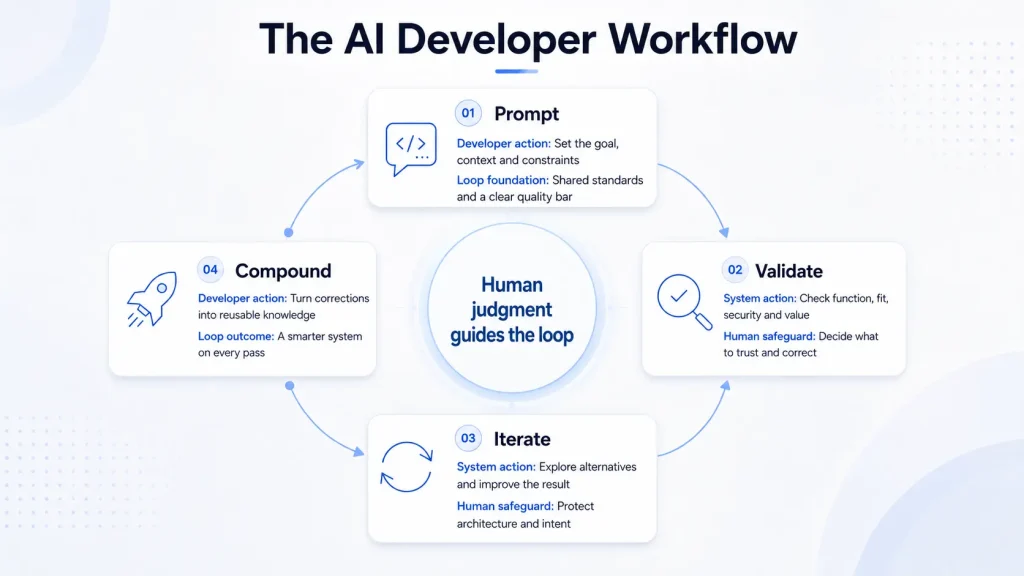
That is why the new AI developer workflow can be summarized in four words: prompt, validate, iterate, compound.
But those four words are best understood not as a checklist to walk through once, but as a loop the team designs once and then lets run, a loop that leaves the system a little smarter every time it turns.
From a linear checklist to a loop that learns
The traditional reading of these steps places the developer inside each one. Prompt, read the output, adjust, read again, test, go back. It is a turn-by-turn conversation, and the developer sits in the middle of it as the bottleneck. It works, but it scales only as far as human attention does.
The more effective model is different. Instead of guiding the AI step by step, the developer gives the system a goal, along with the context it needs to pursue that goal and lets it run the loop.
Prompt becomes the moment the problem is framed. Validate and iterate become activities the system carries out as it works, checking itself and exploring alternatives. And compound is what turns a loop that merely repeats into one that improves.
In this model, the developer’s role does not shrink. It concentrates at the edges of the loop. At the start, the objective must be defined with enough context and constraints that the system can make sound decisions. Throughout, human judgment decides what to trust and what to correct. The demanding middle, the part that once consumed most of the working day, is what the loop handles.
Prompt: context becomes part of the craft
The first step is not asking AI to write code. It is giving AI enough context to produce something useful without a person present to correct it.
A weak prompt usually produces a plausible answer. A strong prompt gives the model a frame: the problem, the constraints, the expected behavior and the quality bar.
There is a significant difference between asking “create an API endpoint” and asking, “create a REST endpoint for this existing service, following the current repository structure, with input validation, consistent error responses and unit tests for the main edge cases.”
The second request does not just ask for code. It frames the engineering problem.
This matters more, not less, once the system runs on its own. When the developer corrects the output every turn, a vague prompt is survivable because drift is caught early. When the loop runs with less supervision, the quality of the objective set at the start largely determines the quality of what comes back.
Validate: AI output is a draft until proven otherwise
AI-generated code can look correct before it is correct. It can compile and still solve the wrong problem. It can pass a simple test and fail in production. It can use outdated patterns, miss edge cases, or introduce security weaknesses that are not obvious at first glance.
That does not make AI unusable. It makes review non-negotiable, and it makes verification part of the loop rather than an afterthought. Validation should happen across different dimensions:
- Functional: does the code do what was requested?
- Technical: does it fit the architecture and existing codebase?
- Security: does it handle input, permissions and sensitive data correctly?
- Quality: is it readable, maintainable and easy to test?
- Product: does it support the user’s need or business outcome?
The goal is not to slow the process down. It is to avoid confusing speed with progress. AI can help teams move faster, but speed without validation simply gets them to the wrong place sooner.
Iterate: use AI to challenge the first answer
One of the most useful aspects of AI is that it lowers the cost of exploring alternatives. Developers can ask for a simpler implementation, a more scalable option, a set of tests, a refactoring proposal, or a review of possible failure points.
Instead of accepting the first suggestion, the team can use AI to pressure test the solution earlier. This is where AI becomes a genuine thinking partner, as long as the developer stays in control of the conversation.
But iteration only pays off if each pass builds on the last. A loop that runs the same way every time is just automation of effort. A loop that improves is something else entirely, and that is what the final step is about.
Compound: each pass should leave the system smarter
This is where the loop earns its name, and where it clearly outperforms a checklist.
A checklist runs once and stops. A loop runs many times, and when it is designed well, each pass is not a repeat of the one before. It is a step up. Every iteration should leave the system a little more capable, because what is learned on one pass is captured and feeds the next. The system is not going in circles. It is compounding.
This changes what the work is for. The instinct inherited from the old workflow is to fix the output: correct this bug, adjust that pattern, move on, and then correct the same class of problem again next week.
The more valuable move is to improve the system itself. When the loop makes a mistake, the correction should become part of what the system knows, so that the mistake is not repeated. Conventions, past decisions, the reasoning behind a tradeoff, the context that would otherwise be re-explained every time, all of it is carried forward.
As Kieran Klaassen, the creator of Compound Engineering, puts it, the goal is to spend roughly half the time doing the work and half teaching the system, so that the next feature is easier because you shipped this one, not harder. If every new feature adds friction and the system never gets smarter, the team has automated the treadmill rather than the work. The opposite is the goal: a loop that is slightly better informed every time it runs, so that over weeks and months it becomes tuned to how the team actually builds.
The developer who embraced AI is still a developer
AI does not replace developers. It increases the importance of human judgment, as developers continue to define problems, validate solutions, and ensure quality, security and value.
The developer who embraces AI uses it to accelerate work, not to replace responsibility, and understands that prompt, validate, iterate, compound reflects what good engineering has always required: clarity, quality and accountability. What changes is that these four words now describe a loop that learns, rather than a line to walk once.
For teams adopting AI, the challenge is not just choosing tools, but designing the right workflow around them, which is why at Xpand IT we help teams integrate AI into the SDLC with the right balance between speed, quality and control. AI may change how we build software, but not why we build it well.