

When organizations evaluate transformation projects, the first question is almost always the same: how much is this going to save?
It is a legitimate question. But it is incomplete. Cost reduction is one possible outcome. It is not the only one, and it is often not the most significant. When it becomes the sole evaluation criterion, we risk making decisions that optimize what is easy to measure and ignore what transforms the way an organization works.
One question remains central: How do we know the investment will pay off?
The answer depends on timing. Organizations that achieve the greatest ROI define success before implementation begins, establish clear metrics and create a baseline to measure real impact.
Measure the current state before transforming it
In almost every project I have been involved in, this step is the one that gets skipped. And it is usually the reason why the results are harder to measure later. Every transformation initiative starts with a business problem. Processes take too long to complete, work is duplicated across teams, approvals create unnecessary delays, or critical information is spread across disconnected systems.
The temptation is often to address these issues by introducing new technology as quickly as possible. However, technology alone rarely solves operational challenges. If the underlying process remains inefficient, digitizing it simply allows the organization to execute the same inefficiencies faster.
Before considering platforms, automation or artificial intelligence, organizations should first understand how work happens today.
This establishes the baseline that makes future improvements more measurable. Without it, any discussion about the ROI of process transformation becomes subjective because there is no reliable point of comparison.
ROI is about more than cost reduction
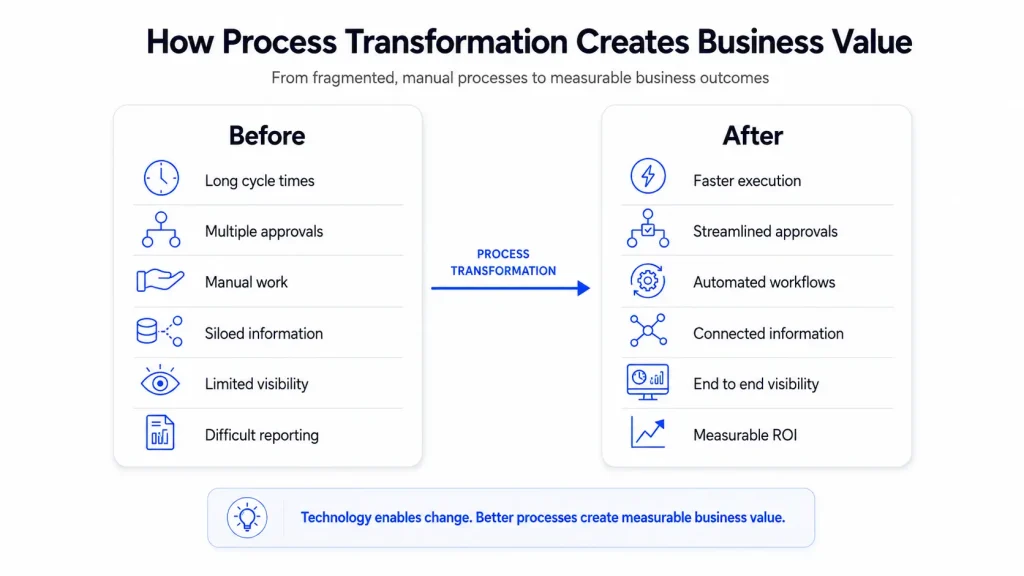
The first improvements often appear in the daily flow of work. Cycle times become shorter, approvals are simplified, and delays are reduced. These changes help control costs while improving how quickly and consistently services are delivered.
Productivity is another relevant dimension. Many employees still spend significant time searching for information, moving data between systems, following up on approvals, or maintaining spreadsheets. Simplifying these activities allows them to focus on work that requires knowledge and judgment.
Better processes can also reduce errors, clarify responsibilities and strengthen traceability. In regulated environments, these improvements support compliance and make it easier to demonstrate that the correct controls were followed.
Together, these changes can contribute to broader outcomes such as faster response times, better service, reduced risk, and more informed decision making.
Build the business case before selecting the technology
Technology should support a clearly defined business objective, not determine the scope of the transformation. A practical baseline can focus on a small set of measures:
- Process cycle time and operating cost;
- Manual effort and repetitive tasks;
- Errors, exceptions and rework rates;
- Number of approvals, handovers and systems involved;
- Operational or compliance risks.
This analysis may reveal that some improvements do not require technology. An approval may be unnecessary; responsibilities may be unclear; or two teams may be performing the same task. Simplifying the process before automating it can create immediate value and reduce implementation complexity.
This baseline gives business and technology teams a shared, evidence-based framework for prioritizing investment and measuring results.
Technology should strengthen a well-designed process, not compensate for a poorly designed one.
Successful process transformation is owned by the business
Process transformation is not just an IT initiative. While technology teams enable change, the business must own the process, define the desired outcomes, and continuously measure performance.
When business and technology work together from the start, organizations are better positioned to improve adoption, demonstrate value and sustain continuous improvement over time.
The B2B success story: building a foundation for measurable value
This is one of the cases that best illustrates what process transformation looks like in practice. B2B, the shared services organization of Grupo Trivalor, was managing critical business processes across spreadsheets, email chains and disconnected documents. This fragmented approach made it difficult to maintain visibility, ensure accountability and demonstrate compliance.
Xpand IT supported B2B in redesigning these processes and implementing a more integrated operating model based on the Atlassian ecosystem. By improving governance, visibility and traceability across critical activities, the organization established a stronger foundation for continuous improvement and measurable business outcomes.
Measuring process transformation ROI starts before implementation
Automation, artificial intelligence and digital platforms can create significant operational value, but only when they address a clearly defined business problem. By measuring the current process, setting target outcomes and estimating the expected benefits before implementation, organizations can make better investment decisions and demonstrate the impact of transformation.
The highest ROI does not come from selecting the most advanced technology. It comes from solving the right problems and measuring the outcomes that matter.