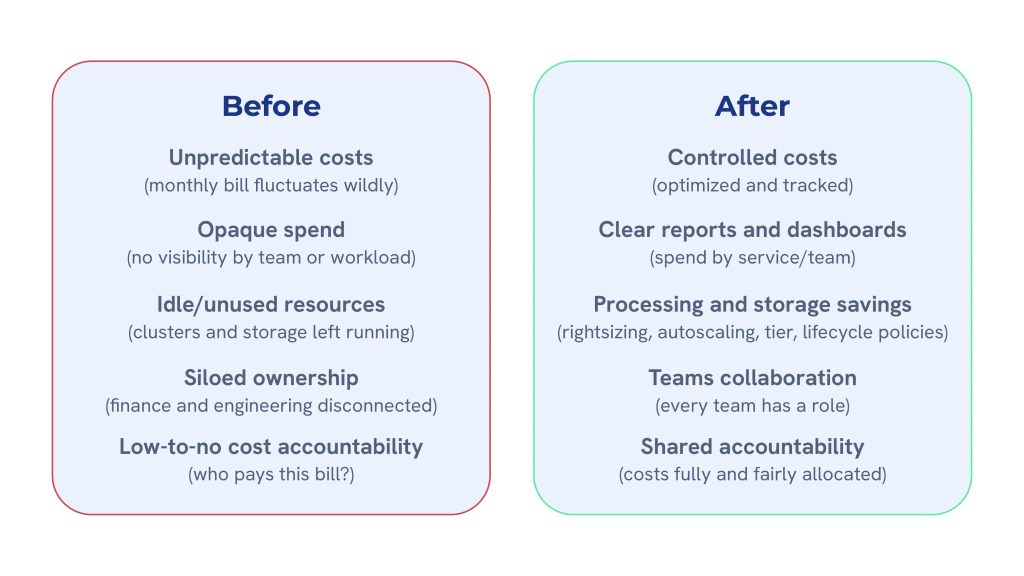

The cloud promised us speed. Nobody warned us about the bill.
Over the past decade, cloud infrastructure has given data teams extraordinary power: spin up a pipeline in minutes, scale computing overnight, run machine learning experiments without buying a single server.
That flexibility has driven real innovation. But it has also created a problem that tends to stay invisible, right up until it shows up in the monthly invoice. When infrastructure scales instantly, so do costs.
Unlike traditional on-premise environments, where physical capacity created natural limits on spending, cloud environments have no such guardrails. Resources expand without friction, which means cost control can no longer be enforced by infrastructure constraints. It has to be governed intentionally through visibility, accountability, and operational discipline. That is the problem FinOps was built to solve.
The concept of FinOps: more than a cost framework
FinOps is often described as cloud financial management, but that framing undersells it. At its core, FinOps is about alignment: bringing engineering, finance and business teams to the same table, speaking the same language about how cloud consumption translates into business value. Applied to data platforms, FinOps moves organizations from reactive cost management to proactive financial governance, where infrastructure investment is planned, tracked, and optimized as a matter of routine. a.
Why data environments are hard to manage
Modern data platforms are inherently complex ecosystems. They combine ingestion pipelines, processing engines, distributed storage, orchestration layers, analytics tools, and increasingly AI and machine learning workloads, often spread across multiple cloud services or providers.
What makes cost management particularly complex is that most of these resources are shared. A single data pipeline may serve multiple business domains. A processing cluster may run workloads from different teams simultaneously, and storage environments often hold datasets consumed by a wide variety of applications. In this context, knowing where costs originate and who should be accountable for them is far from straightforward.
Organizations typically begin to notice the impact of this complexity when costs become difficult to explain or predict. Engineering teams struggle to identify which workloads are driving consumption, while finance teams receive invoices that are hard to interpret or forecast. At the same time, infrastructure continues to grow in the background as data volumes increase and new workloads are deployed.
Some of the most common cost drivers in modern data environments include:
- Shared compute clusters where workloads from multiple teams run simultaneously;
- Data pipelines that process redundant or inefficient transformations;
- Overallocated resources for small workloads;
- Storage growth caused by historical data that remains in high performance tiers;
- Idle infrastructure such as unused virtual machines or always running development environments;
- Limited visibility into how costs should be allocated across teams or products.
In many cases, the problem is not excessive usage but the absence of structured financial governance around that usage. Shared environments can obscure inefficiencies. For example, allocating costs within shared compute clusters, such as Kubernetes environments, or distributed analytics platforms, such as Databricks or Microsoft Fabric, requires clear rules for distributing shared capacity, attributing workload consumption and accounting for unused infrastructure. These challenges are common in large-scale data environments and illustrate why cost governance must be considered from the start rather than added later.
FinOps in Data as an operational and cultural shift
The starting point for this transformation is visibility. Organizations need reliable insight into how cloud resources are consumed, which workloads generate costs and how spending evolves over time. This visibility usually depends on consistent tagging strategies and resource labeling that allow infrastructure usage to be mapped to teams, applications or business functions. Without this foundational layer, meaningful cost allocation becomes extremely difficult. Once visibility is established, accountability follows.
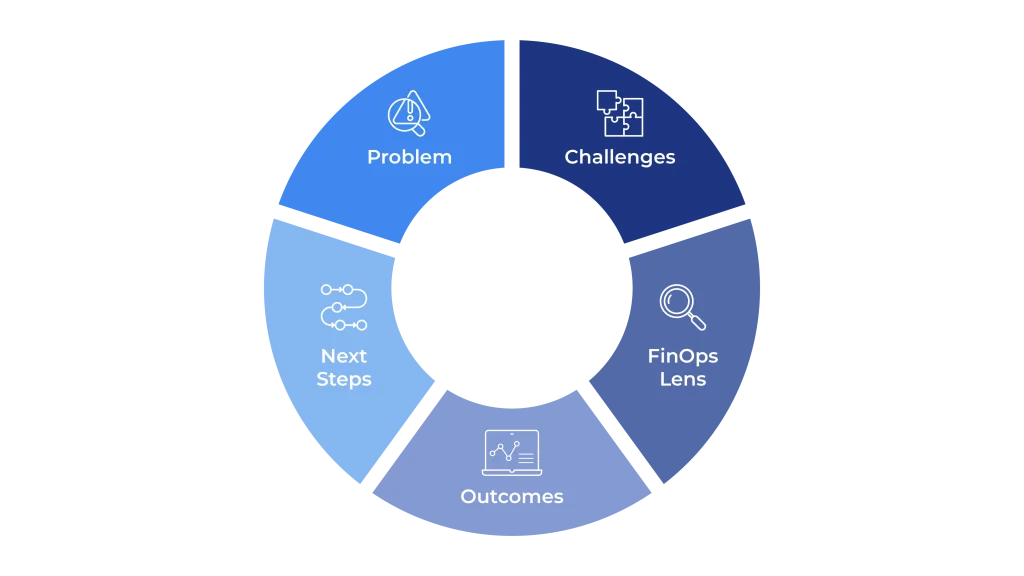
In practice, effective FinOps capabilities usually revolve around three key pillars at Xpand IT, forming a continuous improvement cycle:
1. Problem and Challenges: getting genuine visibility
The starting point is identifying the problems and challenges affecting the organization’s cloud cost landscape. Most organizations have less insight into their cloud consumption than they think. This phase focuses on understanding what is happening in terms of cloud consumption: where costs originate, how resources are shared, which workloads and teams are driving spend, and why costs are hard to predict or explain.
These insights expose inefficiencies, blind spots, and structural issues – such as lack of tagging, shared infrastructure, or opaque usage patterns – that justify the need for FinOps practices and targeted governance strategies.
2. FinOps Lens: what FinOps has to say about this?
Once challenges are understood, they are analyzed through a FinOps lens. This step focuses on how to address the identified problems by applying FinOps domains and capabilities, such as cost allocation models, chargeback or showback mechanisms, workload optimization, rightsizing, and forecasting.
The goal is not only to reduce waste, but to optimize cloud usage in a way that balances cost, performance, and business value, making financial efficiency a shared responsibility across engineering, finance, and business teams.
3. Outcomes and Next Steps: measure Success, Improve
The final pillar focuses on measuring the outcomes of the applied FinOps practices and defining the next actions. This includes tracking the impact of optimization measures, assessing improvements in cost visibility and accountability, and identifying further opportunities as workloads and usage evolve.
These outcomes inform the next iteration of the cycle, reinforcing operational discipline and progressively increasing FinOps maturity across the organization.
FinOps maturity depends as much on culture as on technology. The technology matters, but so does the culture. Engineers need to treat financial efficiency as a natural dimension of system design, as normal as reliability or performance. Finance teams need to understand what actually drives infrastructure consumption. And leadership needs to treat cloud cost metrics as indicators of operational health, not just a line item to minimize.
The goal isn’t less spending: it’s better spending
This is where many FinOps conversations go wrong. Cost reduction is a tactic, not a strategy. Cutting cloud spend indiscriminately can undermine the very reason organizations moved to cloud in the first place: agility, scale, and the ability to experiment.
The real question is whether cloud investment generates measurable business value. Sometimes that means reducing waste. Sometimes it means increasing investment in processing capacity, advanced analytics, or AI workloads that unlock new capabilities.
Mature FinOps practices support both. Forecasting becomes essential: by analyzing workload patterns and infrastructure drivers, organizations can anticipate how consumption will evolve and avoid unexpected cost spikes. And communicating this clearly to business stakeholders requires translating technical metrics into terms that resonate: cost per data product, cost per pipeline execution, cost per analytical insight.
Cloud spending will keep growing as data volumes increase and use cases multiply. The organizations that manage this well won’t be the ones that spend least. They’ll be the ones that spend with intention.