

Digital channels are often evaluated by what users see: intuitive interfaces, seamless journeys and responsive experiences. But what truly determines whether a digital channel delivers value consistently is not just technology: it is alignment, clarity and quality.
This is where Business Analysis and Quality Assurance (BQA) becomes essential.
BQA ensures that digital solutions are not just built correctly, but built with purpose. It guarantees alignment throughout the entire development lifecycle: from understanding the business context, to translating needs into clear requirements, and to ensure delivery with measurable quality.
In complex digital transformation initiatives, that alignment is not optional. It is structural. Excellence is engineered long before delivery, which is why business analysis and quality assurance form the true backbone of digital channels.
Quality as a competitive advantage for companies
In a global environment marked by uncertainty, operational pressure, and the demand for rapid efficiency, quality can no longer be seen as a cost center, but rather as a driver of optimization and risk reduction.
Organizations cannot afford misaligned requirements, rework cycles, production errors or unclear ownership between business and technology teams. Every inefficiency directly impacts ROI, time-to-market and stakeholder trust. In this context, BQA gains strategic relevance.
By combining structured Business Analysis with proactive Quality Assurance, organizations strengthen:
- Trust in digital platforms;
- Operational efficiency;
- Data-driven decision-making;
- Risk mitigation;
- Sustainable growth.
Quality becomes a competitive differentiator, not just a checkpoint at the end.
Business Analysis : bridging the gap between business and technology
Digital channels fail when business intent is lost in translation; Business Analysis ensures that this does not happen.
It acts as the strategic bridge between vision and execution, aligning stakeholders, developers, UX/UI and QA teams from the very beginning.
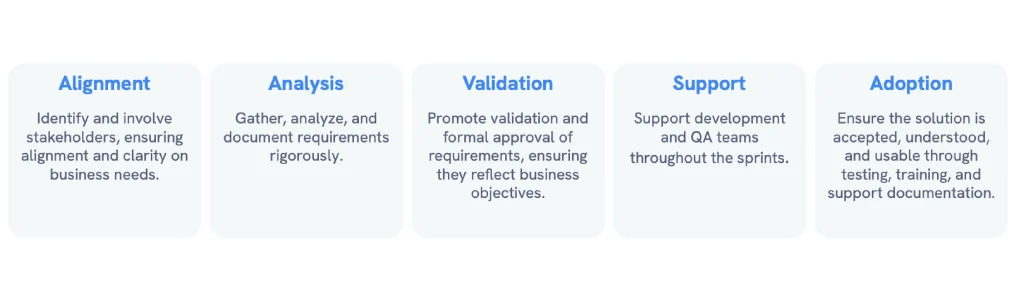
The work of Business Analysis begins with stakeholder alignment. It ensures clarity around business objectives, success metrics and operational constraints. This early alignment is critical to prevent fragmented decisions and future misinterpretations
Then, requirements are gathered, analyzed, and documented with rigor. Ambiguities are addressed proactively, reducing the risk of inconsistencies that could otherwise translate into costly rework or defects in later stages.
Formal validation plays a decisive role in this process as requirements are reviewed and approved to ensure they accurately reflect business goals.
Throughout the delivery cycle, Business Analysts remain actively involved, supporting development and QA teams during sprints. They clarify evolving requirements and adapt to change without losing strategic direction.
Business Analysis also acts beyond technical delivery. It ensures that solutions are accepted, understood, and effectively adopted through user training, and solid documentation. The value of Business Analysis is not limited to documentation; it has a pivotal role in defining the right thing to build.
Quality Assurance: the key to a structured and continuous delivery cycle
If Business Analysis defines what must be built, Quality Assurance ensures it works reliably, consistently and at scale.
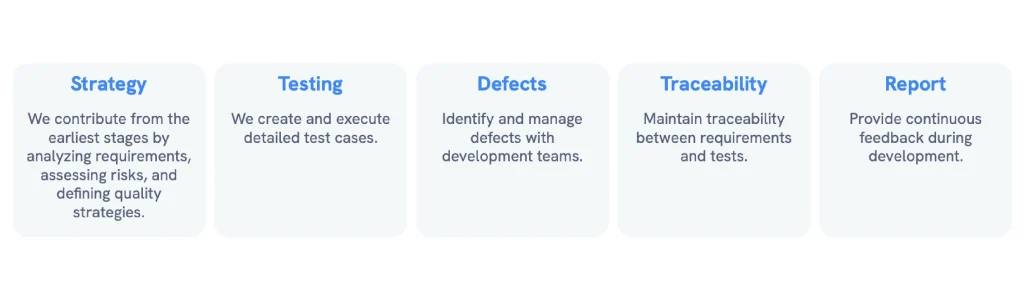
Quality Assurance begins with a clear quality strategy, grounded in requirement analysis, risk assessment, and overall delivery objectives. Rather than acting as a reactive checkpoint, QA contributes from the earliest stages to ensure that quality is embedded from the start.
Based on this strategic foundation, detailed test cases are designed and executed to validate both functional and non-functional requirements, ensuring that the solution performs as intended across different scenarios and conditions. Throughout the process, errors are identified, prioritized, and resolved in close collaboration with development teams. This foster shared accountability, and continuous improvement.
A critical element of this approach is full traceability between requirements and test cases. This guarantees that business intent is consistently reflected in system behavior, and that no requirement is overlooked during validation.
At the same time, continuous reporting and structured feedback loops provide visibility into quality status, emerging risks, and opportunities for optimization. By enabling early validation and testing parallel to development, QA reduces delivery risks, shortens feedback cycles, and accelerates time-to-market.
The impact of BQA in project excellence
A mature BQA capability has a direct and measurable impact on business performance.
With this capability in the delivery lifecycle, organizations can:
- Reduce ambiguity and errors. Business Analysis prevents errors at the source by clarifying objectives, resolving ambiguity, and ensuring stakeholders share a common understanding. Quality Assurance complements this approach by detecting technical errors early through structured test design and rigorous validation. Together, they work to prevent issues from reaching live environments andprotecting operational continuity and brand credibility.
- Ensure system reliability. BA ensures thar requirements accurately represent business intent and user needs, reducing the risk of gaps or misinterpretations. QA continuously verifies system behavior, integrations, performance, and functionality, ensuring stability as digital channels grow in complexity.
- Improve customer satisfaction. BA ensures that solutions are designed to deliver meaningful outcomes aligned with user expectations and business goals. QA ensures these outcomes are delivered reliably by validating acceptance criteria, reducing friction, and enabling predictable, high-quality digital experiences.
- Optimize the delivery. BA accelerates alignment and decision-making by engaging stakeholders early and preventing rework from misinterpretations. QA accelerates development by providing rapid, early detection of errors, and close collaboration with engineering teams, jointly reducing uncertainty and avoiding costly rework.
- Minimize risk and cost. BA mitigates strategic and requirement–related risks by ensuring clarity and preventing misaligned decisions. QA mitigates executional and operational risks by reducing post-deployment failures and limiting corrective efforts, lowering operational expenses and protecting return on investment.
- Promote a quality culture. BA promotes clarity, accountability, and shared understanding across teams, while QA instils disciplined engineering practices and continuous validation. Together, they elevate organizational standards and foster a culture of improvement and delivery excellence.
When Business Analysis sets direction and Quality Assurance Ensure end-to-end quality across the solution, BQA becomes a strategic capability. These areas jointly provide the structure that enables digital channels to deliver not just features, but clarity, stability, and measurable business outcomes.
In a landscape where expectations evolve faster than technology, sustainable digital excellence depends on one principle: delivering value consistently and with confidence. That is what a strong BQA discipline enables: investing in clarity, alignment, and quality is no longer optional. It is how organizations build trust, resilience, and digital experiences that last.
About Xpand IT
IT Solutions driven by Excellence
Founded in 2003, Xpand IT is a global IT consulting company with over 20 years of experience delivering strategic and technological solutions that drive business excellence.
With a presence in more than 30 countries, 4 subsidiaries and a portfolio of 900+ clients, we support organizations across industries in navigating complex digital challenges and unlocking new opportunities for growth.
We help companies shape their Data Journeys, enhance Customer Experience, accelerate Workplace Transformation, deliver Cloud services, and harness the power of Artificial Intelligence — combining deep technical expertise with a strong business focus to create sustainable impact.