

In today’s fast-paced digital landscape, companies need actionable insights to drive decision-making and fuel innovation. Data science plays a crucial role in this process. It provides the tools and methodologies to transform raw data into valuable business intelligence. However, success in data science requires more than just technology — it demands a clear, structured, and flexible approach that responds to business needs and technical challenges.
At Xpand IT, our Data Science team has developed a 3-step process to ensure project success within an agile framework. In this blog post, we will guide you through each step and show how we align data science initiatives with real business goals.
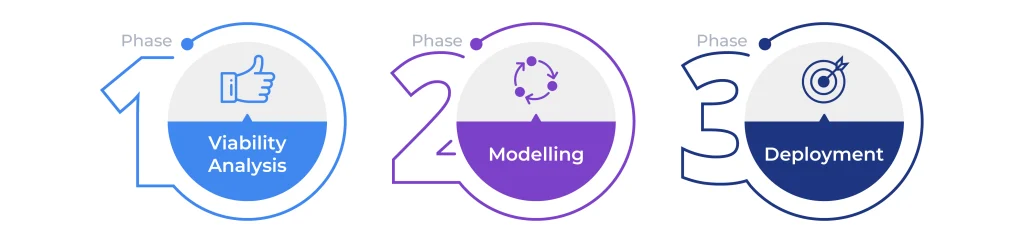
Step 1: Viability Analysis
The first step in any data science project is understanding the business problem. We assess whether a data-driven solution is both feasible and valuable. This phase focuses on three key components:
Business component: We begin by defining the business goal, the efficiency metrics, and the challenge to be addressed. Our team reviews existing solutions and ensures that the proposed solution fits the current business process.
Data component: A solid project depends on solid data. We evaluate the quantity, quality, and relevance of the available data. At the same time, we identify any gaps that could impact results.
Deployment component: For successful deployment, we address data preprocessing, infrastructure, and model maintenance. We ensure consistency, plan for performance monitoring and retraining, and take into account the client’s needs and budget.
By the end of this phase, the business problem, success criteria, and stop criteria are all clearly defined. We conduct a risk survey to anticipate possible issues. Then, we plan the next phase and select the most suitable frameworks and technologies for the first modelling iteration.
Step 2: Modelling
Once we confirm that the project is viable, we move into the modelling phase. This is an iterative process where models are tested and compared until one meets the defined stop criteria. Each cycle includes three sub-stages:
Data Preparation: Data scientists often dedicate a significant amount of time to preparing data. We define rules for data selection and cleaning to ensure the input is reliable.
Data Exploration: In this stage, we explore the data to formulate and test hypotheses. We use visualizations and apply feature engineering techniques to enrich the dataset.
Modelling: This stage is divided into four key steps: setting ground rules, selecting the model, training and tuning, and finally, validation and comparison.
Step 3: Deployment and Monitoring
After selecting the right model, we move to deployment. But putting a model into production is not the final step — continuous monitoring and maintenance are essential to maintain value in deliveries.
Deployment: We document which models can be integrated into the client’s systems. For each one, we create a step-by-step implementation plan, considering technical requirements like output formats and system constraints. We also prepare a risk analysis and a contingency plan.
Monitoring: After deployment, the model’s performance must be tracked. If results decline, retraining or adjustments may be necessary. We apply both reactive and proactive monitoring to ensure the solution remains effective.
Conclusion: Ensuring success through an agile data science process
This 3-step data science process bridges agility and structure. At Xpand IT, we deliver high-quality results while adapting to each client’s reality. The process ensures that no critical steps are missed. It is robust, yet flexible — not a one-size-fits-all method. As the data science field evolves, we continue to improve our approach by adopting the latest techniques and technologies.